 Image 1 of 2
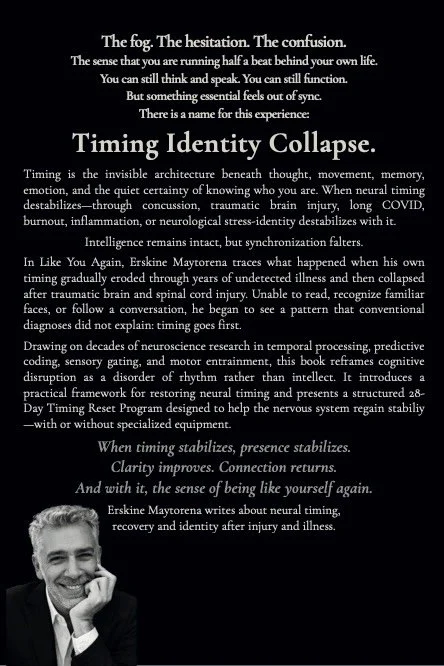 Image 2 of 2
A Book About Timing Identity Collapse
The fog. The hesitation. The confusion.
The sense that you are running half a beat behind your own life. You can still think and speak. You can still function… But something essential feels out of sync.
There is a name for this experience: Timing Identity Collapse.
Timing is the invisible architecture beneath thought, movement, memory, emotion, and the quiet certainty of knowing who you are. When neural timing destabilizes-through concussion, traumatic brain injury, long COVID, burnout, inflammation, or neurological stress-identity destabilizes with it.
Intelligence remains intact, but synchronization falters.
In Like You Again, Erskine Maytorena traces what happened when his own timing gradually eroded through years of undetected illness and then collapsed after traumatic brain and spinal cord injury. Unable to read, recognize familiar faces, or follow a conversation, he began to see a pattern that conventional diagnoses did not explain: timing goes first.
Drawing on decades of neuroscience research in temporal processing, predictive coding, sensory gating, and motor entrainment, this book reframes cognitive disruption as a disorder of rhythm rather than intellect. It introduces a practical framework for restoring neural timing and presents a structured 28-Day Timing Reset Program designed to help the nervous system regain stability, with or without specialized equipment.
When timing stabilizes, presence stabilizes. Clarity improves. Connection returns.
And with it… the sense of being like yourself again.
A Book About Timing Identity Collapse
The fog. The hesitation. The confusion.
The sense that you are running half a beat behind your own life. You can still think and speak. You can still function… But something essential feels out of sync.
There is a name for this experience: Timing Identity Collapse.
Timing is the invisible architecture beneath thought, movement, memory, emotion, and the quiet certainty of knowing who you are. When neural timing destabilizes-through concussion, traumatic brain injury, long COVID, burnout, inflammation, or neurological stress-identity destabilizes with it.
Intelligence remains intact, but synchronization falters.
In Like You Again, Erskine Maytorena traces what happened when his own timing gradually eroded through years of undetected illness and then collapsed after traumatic brain and spinal cord injury. Unable to read, recognize familiar faces, or follow a conversation, he began to see a pattern that conventional diagnoses did not explain: timing goes first.
Drawing on decades of neuroscience research in temporal processing, predictive coding, sensory gating, and motor entrainment, this book reframes cognitive disruption as a disorder of rhythm rather than intellect. It introduces a practical framework for restoring neural timing and presents a structured 28-Day Timing Reset Program designed to help the nervous system regain stability, with or without specialized equipment.
When timing stabilizes, presence stabilizes. Clarity improves. Connection returns.
And with it… the sense of being like yourself again.